 Up to 80% off!


 Call Us


 WhatsApp
 Facebookk
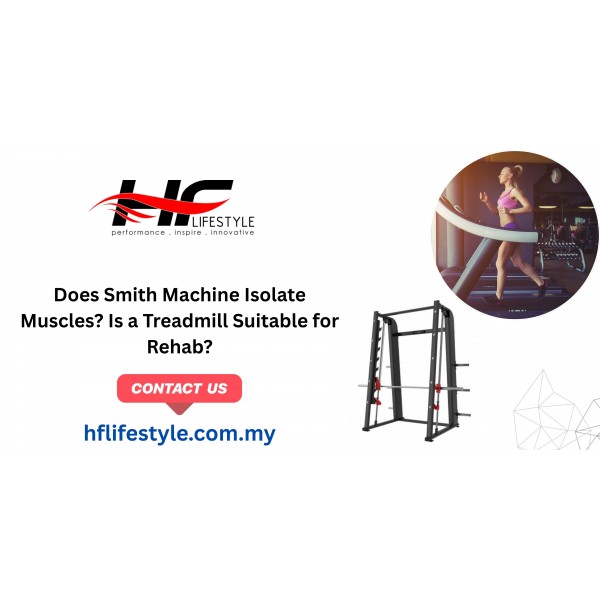
Does Smith Machine Isolate Muscles? Is a Treadmill Suitable for Rehab?
 Apr 23, 2026
A Smith machine is a weight training piece of equipment that is made up of a barbell that is attached to rails made of steel. This arrangement can only enable the bar to move in a vertical or slightly angled direction.
The Smith machine also does not require the lifter to stabilize the bar in various directions, as would be the case with free weights. Rather, the machine controls the movement, which makes exercises more predictable and controlled.
History and Evolution of the Smith Machine
The Smith Machine was invented in the 1950s and popularized by the fitness guru Jack LaLanne and later improved by gym equipment designer Rudy Smith, to whom it is named.
Gradually, it became a gym staple because of its:
- Safety features
- Ease of use
- Adequacy to train without a spotter.
It is commonly used in commercial gyms and indoor systems today to do strength training and bodybuilding.
Does the Smith Machine Isolate Muscles?
Yes, the Smith machine does not isolate muscles since it does not offer a stabilizer muscle, as it offers a fixed bar path. This enables specific muscle training, such as chest, shoulders, and legs, to be done, and it can be applied to beginners as well as controlled strength training in workouts and high-intensity level of training in rehabilitation programs, in general, safe and effective training use.
Best Smith Machine Exercises for Isolation
Smith Machine Squats
Smith Machine squats are mainly concentrated on the quadriceps and glutes with minimal balance requirements. Foot placement alters muscle focus and has proved to be useful in controlled lower-body isolated training.
Smith Machine Bench Press
The Smith machine bench press decreases the demands of shoulder stabilization and allows the chest muscles to act more directly. This assists in enhancing the chest action and controllable strengthening.
Smith Machine Lunges
Smith machine lunges offer a stable and controlled motion pattern, which improves muscle isolation. They are efficient in targeting the quadriceps, glutes, and hamstrings, and have less balance and coordination needs.
Why People Think It Isolates Muscles
Most people who lift on the Smith machine think that the machine isolates muscles due to:
1. Fixed Bar Path
The bar is placed on rails and thus does not require balance control in several directions. This inhibits the stimulation of stabilizer muscles such as:
- Core muscles
- Lower back stabilizers
- Smaller joint-support muscles
2. Less Coordination Required
Free weight exercises are coordinated and balanced. The Smith machine eliminates much of this load, and the motion will seem more directed to the muscles of interest.
3. Easier Mind-Muscle Connection
Since it is less stable, certain users believe that they have more time to concentrate on the target muscle, particularly in activities such as squats or bench press.
Smith Machine vs Free Weights (Muscle Activation)
| Feature | Smith Machine | Free Weights |
| Stabilizer engagement | Low | High |
| Muscle isolation | Moderate | Lower (compound focus) |
| Balance requirement | Minimal | High |
| Safety | Higher (with locks) | Depends on technique |
| Natural movement | Limited | Fully natural |
When the Smith Machine Helps Muscle Focus
Although it does not completely isolate the muscles, it could be applied in particular cases.
1. Bodybuilding and Hypertrophy Training
The Smith machine aids controlled movement, more time under tension, and enables muscles to be trained closer to failure to achieve better growth outcomes.
2. Beginners Learning Form
Novices enjoy heightened balance, learning mobility, enhanced self-confidence, and less risk of injury as they engage in simple strength training activities.
3. Injury Rehabilitation or Joint Limitations
It assists injured people to manage the range of movement, decrease instability, and prevent strain, as well as safely re-establish strength during the period of recovery training.
4. High-Volume Training
Stabilizer load is minimized, and with more repetitions, a little heavier load, and more focus on muscle fatigue during high-volume workouts can be achieved.
Introduction of a Treadmill or Rehab
A treadmill is a form of exercise that involves walking and running under strict control, commonly used in rehabilitation to restore mobility, strength, and balance.
In rehab centers, treadmills are usually used in:
- Rehabilitation of (knee, hip, ankle) post-surgery.
- Rehabilitation of stroke patients
- Rehabilitation of sports-related injuries
- Conditioning of the cardiovascular system.
- Training of balance and gait.
Treadmills are safer than outdoor walking, as they provide a predictable and stable surface for patients recovering from injuries.
Is a Treadmill Suitable for Rehab?
Yes, treadmills can be used for rehabilitation purposes and are typically used in recovering from surgeries, injuries, and neurological diseases. Treadmills provide controlled walking and walking speed, which promotes balance and strength without putting any stress on the patient. Regular treadmill therapy supports gradual recovery and enhances overall physical function effectively today.
How a Treadmill Helps in Rehabilitation
Physiotherapy Treadmill training is extremely popular in physiotherapy as it enables gradual movement progression. How it helps:
Improves Walking Pattern (Gait Training)
Treadmill training is used to help patients regain their normal walking pattern, which improves their strides, balance, and foot coordination.
Builds Strength Gradually
Treadmill training is used to train patients gradually, where the patient starts walking slowly and increases his/her pace.
Enhances Joint Mobility
Treadmill training increases joint flexibility by reducing stiffness and improving joint lubrication in joint and ankle rehabilitation.
Supports Cardiovascular Recovery
Treadmill walking is also a safe way to restore heart and lung stamina following inactivity or surgery, and enhances endurance, circulation, and cardiovascular health.
Boosts Balance and Coordination
The rehabilitation provides balance and coordination with the help of controlled movement, handrails, or safety harnesses, enabling patients to walk safely and with confidence, and minimize the risk of falling.
When is a Treadmill Suitable for Rehab?
A treadmill can be used in the following situations:
✔ Post-Orthopedic Surgery
- Knee replacement
- Hip replacement
- Ligament repair (ACL injuries)
✔ Mild to Moderate Sports Injuries
- Muscle strains
- Repair of ligaments (ACL injuries)
✔ Neurological Recovery
- Stroke rehabilitation
- Mild balance disorders
✔ General Deconditioning
- Following prolonged bed rest or disease.
Risks of Using a Treadmill in Rehab
Though mostly safe, its abuse may cause:
- Pain or inflammation.
- Weak development in walking posture.
- Overuse injuries
- Falls (if unsupervised)
- Delayed recovery due to overexertion
That is why the supervision of a physiotherapist is highly recommended.
Treadmill vs Outdoor Walking in Rehab
| Feature | Treadmill | Outdoor Walking |
| Surface | Controlled | Uneven |
| Safety | High | Moderate |
| Monitoring | Easy | Difficult |
| Weather Dependence | None | Yes |
| Adjustment | Speed & incline controlled | Not controlled |
It is safer to use treadmills in the initial phases of rehabilitation, whereas walking outdoors is preferable in advanced rehabilitation.
Conclusion
Both the Smith Machine and the treadmill have a significant purpose in fitness and rehabilitation. Smith machine is used to train and isolate controlled muscle movements, and treadmills are used to promote safe movement. Both tools are useful as they enhance strength, balance, and endurance when used effectively, and therefore, they are useful among beginners and rehabilitation programs of athletes under supervision.